
Does God Have Favorites?

Favorites


Does God have favorites?

Perhaps John, one of the twelve disciples, thinks so. In the gospel given his name, John refers to himself as “the disciple whom Jesus loved” on at least six occasions. Along with Peter and James, John was part of Jesus’ inner circle affording him access to a part of Jesus’ life that many did not see. It was John who initiated a dispute with the other disciples about which of them was the greatest. And it was John that Jesus asked to look after his mother, Mary, after His death. John was the only one of the disciples not to die of martyrdom (excluding Judas who committed suicide). Instead, John died a natural death after being exiled to the island of Patmos.

Was John one of Jesus’ favorites?

Peter might agree. There’s a telling story in John 21 where Jesus appears to the disciples after his resurrection. The disciples have been fishing but have caught nothing. Jesus allots them a miraculous catch of fish and they have breakfast with Him on the beach. Peter is reinstated three times with the question, “Do you love me?” – one for every time he denied Jesus. And then Jesus tells Peter about his future – that he will die for the cause of Christ. Peter is taken back by the news and wants to know how John’s life will end. Peter asked Jesus, “What about him, Lord?” Jesus replied, “If I want him to remain alive until I return, what is that to you? As for you, follow me.”

What is that to you?

Let those words hang in your mind for a moment. Jesus makes it clear to Peter that he shouldn’t concern himself with John’s future. Peter’s calling is clear – just “follow me.” His only interest was to be obedient to Jesus’ invitation. Likewise, we are not to concern ourselves with whether we might be favored, other’s fortunes and exploits, or their providences or callings, but only our call to be obedient to Jesus.

Just follow Jesus.
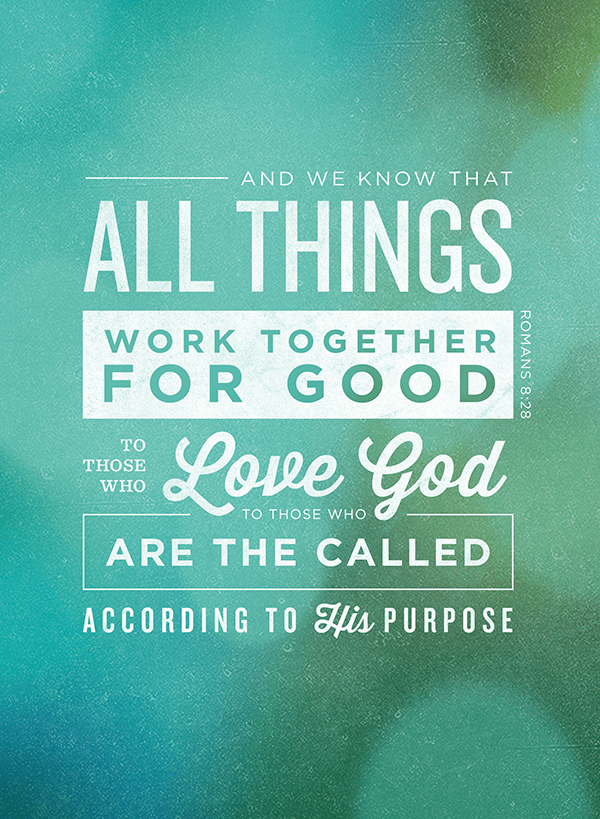


Do All Things Really Work for Good?


All Things

And we know that for those who love God all things work together for good…

Romans 8:28

This verse is often used to encourage those who are going through a tough time – reminding them that it will eventually work out for something good in their life. For example – don’t worry about getting fired – God has something better in store for you. All things work out for good, remember?

While it is a very comforting and hopeful verse, particularly while navigating though the tough circumstances of life, there are two cautions to deal with to keep this passage in its proper context:

  1. The passage deals with those who love Christ.

It may appear to be semantics. Who doesn’t love Christ, right? But it’s a very important distinction. The verse is specifically for believers – those who believe Jesus Christ is who He says He is.

  1. The “good” that is described is our ultimate conformity to Christ not our comfort.

The “good” that is referred to here doesn’t necessarily mean our circumstances will go from bad to good. Things might get better after the loss of our job, they might not. Rather the “good” is that which leads to our sanctification – growing us closer to Christ. The word literally means “useful.” It’s all about the ultimate good, that which is best for us, not necessarily that which makes us feel better.

There are times it is really difficult to see the good in life’s challenges. But remember, for those who love Christ, He is always working good in our lives. We may not see it. We may wonder. But we can be assured that all things really do work for good!


Do We Really Want to Know Why?

Suffering

Continuing in our series, Asking for a Friend, it’s the universal question: Why do bad things happen to good people? You can check out my message here https://youtu.be/Mg_Vo2JCeXA. But do we really want to know why?

Every baby’s arrival on planet earth is a memorable occasion. The birth of our second was nothing less. It was a scheduled induction a week after his due date. We arrived at the hospital and went through the customary routine. Amy was hooked up to the fetal monitor that registered her contractions and the baby’s vitals. The medication drip was started. The doctor had the rousing pre-game talk with us. And we waited. As the drip kicked in, the contractions commenced. With each passing contraction, the grimace on Amy’s face amplified. It appeared her pain was intensifying, but the monitor was only showing measly escalations. I was getting concerned because she was obviously in pain but there didn’t appear to be a reason for it. I’m smarter than I look (and I enjoy life), so I restrained from sweetly saying, “Suck it up, buttercup!” About that time, the nurse came in the room to do a regular check and noticed the monitor was not placed in the correct position. She adjusted a few things just as another contraction began and the display soared off the screen! Uh, where’s the epidural?

Imagine you are walking down a hallway in a hospital. You hear a woman crying out in pain. Standing outside her room are her family and friends who are chatting it up and even laughing seemingly unaware of the howling coming from the room. You stop and say to them, “What is wrong with you? Can’t you hear how much pain she is in?” They look at you like you are crazy and reply, “She’s having a baby! We are so happy!”

In some cases, when we know why, the pain doesn’t seem so bad anymore. We can tolerate suffering when we know why it is happening. I was bothered by Amy’s pain when the monitor wasn’t correlating with her grimaces. But once it made sense, I was better with it. And then there are other cases where even if we had the answer to why, we can’t imagine that it would possibly even come close to alleviating our pain.

Every one of us who suffers wants to know why. But what if we found the answer? What if the mystery were finally solved? If this ultimate question were answered, then would we be able to make peace with the suffering of “good” people? If we knew why we would no longer be bothered by their cry, we would no longer feel their pain, because we would understand why it is happening.

It’s the search for the why that draws us closer to God. In the middle of our suffering, we have two options. We can use our confusion, hurt and anger to draw us closer to God or we can make it an excuse to run from God. It’s also the search for why that draws us closer to others. We can enter their pain and confusion. So, let’s keep asking the question. Allow the question to draw you closer to God. In fact, allow the question to propel you into action. When you see “good” people suffering, hear their cry, feel their pain, and move into action to help them. And so, in your suffering, may you receive the same.


Is Suicide an Unpardonable Sin?

asking

We just launched a new sermon series at Aldersgate Church titled, “Asking for a Friend.” You know the questions – the ones you don’t want to ask at the risk of sounding silly or being embarrassed. Better to make your friend look ridiculous, right? We’ve learned that you have lots of friends with lots of hard questions!

One question that came up numerous times is around the matter of suicide and whether suicide can be forgiven by God. Many grapple with the question because they have a friend or loved one who has taken their own life. Some question because they have heard teaching that it is certainly an unpardonable sin. And still others are intrigued by the Netflix series “Thirteen Reasons Why” that just released its second season.

I recently sat down with a good friend of mine, Renee Ross, who is living in the wake of such tragedy. Her son, Riley, took his life at 21 years of age. Renee never asked for the platform she has but is taking full advantage of the opportunity God has given her. You can catch that interview here. It’s definitely worth your time to hear Renee’s story. Allow me to add some additional commentary here.

The Bible records six incidents where a person takes his own life: the case of Abimelech (Judges 9:50-57), Samson (Judges 16:28-30), Saul and his armor-bearer (1 Samuel 31:1-6), Ahithophel (2 Samuel 17:23), Zimri (1 Kings 16:18-19), and Judas (Matthew 7:25). In none of these is an explicit moral evaluation or judgment rendered, but it is worth noting that none of these cases were met with God’s approval.

Here is what we know:

  1. Suicide is a sin.

A traumatic event, a death in the family, a series of bad experiences, severe depression or mental illness —all of these things can lead us down into the valley of death’s shadow. But suicide is never considered to be an option for escaping a time of difficulty and despair. It is not a good conclusion and becomes a sin because it robs a person of the sanctity of life and the full time given to them by God.

  1. Suicide is not an unforgivable sin.

Nowhere does the Bible say that suicide is unforgivable or unpardonable. The Bible teaches that all sin – past, present, and future – is forgiven through the grace of God. One’s eternal destiny is sealed and set at the moment of trusting Jesus for salvation. This is the most important decision that can ever be made in life. And there is not another decision after the decision to follow Jesus (short of perhaps outright rejecting Him) that can negate that decision.

Some argue that a person who commits suicide cannot repent of the sin and therefore it is unforgivable. But who will really have the time to confess every single sin before they die? Some of us will die instantly, without warning. Others may slowly die, but even then—after we confess as many sins as we can think of—there are still sins that we have committed against God and our neighbor that we aren’t even aware of! So, the usual reason given for suicide being an unforgivable sin doesn’t seem to hold up to the Bible or experience.


There are obviously difficult and challenging questions the Bible simply does not directly address. But this one thing is certain. Suicide is always a tragedy and most assuredly a sin that violates the sanctity of life. But in itself is not the unpardonable sin. There is no evidence to conclude that it is beyond the reach of forgiveness obtained for us at the cross of Christ. The only sin God cannot pardon is the sin of rejecting him.

I’d love to hear your thoughts and struggles with this question.