What Are You Known For?

generosity

What is it that you are really good at? What do people know you for? When you are talked about in circles behind your back what is said about you? What will people remember about you at your funeral? Take some time to really think about that. Ask yourself, “What am I known for?”

In 2 Corinthians, Paul writes to the church and spells out what it is they are known for:

But as you excel in everything – in faith, in speech, in knowledge, in all

earnestness, and in our love for you…  2 Corinthians 8:7

Paul commends the Christians at Corinth for their faith, their gifted speakers, their intellect, their passion, and their love. But then he says that he wants them to be known for this one additional act of grace:

…see that you excel in this act of grace also.  2 Corinthians 8:7

What was this act of grace? Not grace itself, although that is a good thing to be known for, but a particular act of grace. Well, we must look at the rest of the story:

We want you to know, brothers, about the grace of God that has been given

among the churches of Macedonia, for in a severe test of affliction, their

abundance of joy and their extreme poverty have overflowed in a wealth

of generosity on their part.2 Corinthians 8:1-2

Paul wants the Christians at Corinth to be known for their generosity. He is telling them about the churches in Philippi, Thessalonica, and Berea and their generosity, even in the midst of their poverty. And he wants the church at Corinth to be known for the same.

What about you? Are you known for your generosity? Do you excel at giving? When people talk about you do they talk about open-handed you are with your money, your time and your talent? Will others remember that about you when you’re gone?

If you want to be known as a generous person, the time to start is now! If you wait until your rich, you’ll never be generous. If you wait until you have more, you’ll never be charitable. If you wait until you get to where you want to be, you’ll never be known as a giving person. Giving starts where you are, not where you want to be. Generosity starts today!


Growing People Grow Together

Small Group

This week we come to our value at Aldersgate of living in community with other people. God’s desire is for us to grow in relationship with Him as we grow in relationship with others. Growing people grow together.

God himself lives in relationship. He exists in three persons: Father, Son, and Holy Spirit. All three persons of the Trinity were present at creation when God make the sun and the moon, the sea and the land, and all the animals. He made man and then shook his head and said,“It is not good that the man should be alone; I will make him a helper fit for him” (Genesis 2:18). Jesus modeled living in community when He came to earth. Jesus loved everybody, fed the crowd, trained the group, discipled a few and mentored the closest. The Bible says we are “put together, joined together, built together, members together, heirs together, fitted together, held together, and we will be caught up together.” We are commanded to “love each other, pray for each other, encourage each other, admonish each other, greet each other, serve each other, teach each other, accept each other, honor each other, hear each other’s burdens, forgive each other, submit to each other, and be devoted to each other.”

Who are you doing this with?

Growing people grow together. If you missed this Sunday’s message I encourage you to check it out here . At the least, please spend time this week reading the story of Mark 2:1-12. In this story, we find a paralyzed man who was brought to Jesus by his friends. A great example of community that challenges us to do the following:

  1. Make Friends Who Are Bringing Me to Jesus.

I can be surrounded by lots of “friends” yet none of them are bringing me closer to Jesus. In fact, they might be taking me farther away from Jesus. We need friends who are willing to take us to the feet of Jesus. Those who are willing to ask the difficult questions, tell us the hard truth and keep us on the right track. Do you have those friends in your life?

  1. Trust My Friends to Bring Me to Jesus.

Think of the trust the paralyzed man had to have to let his friends carry him to the roof and lower him down through the ceiling. He’s developed this trust with them because he depends on them for everything. He needs help getting fed, getting dressed, and getting cleaned. The truth is we all have to depend on others. And we all have a mat. That thing that makes us vulnerable. That thing we have to trust others with. It might be a feat, a temper, a secret that no one else knows about. Who do you trust with your mat?

  1. Make Friends Who Bring Me to Jesus a Priority.

People rarely drift into rich relationships. You can sit in church every Sunday and not find community. Or you can avoid church all together to stay away from the relational mess. But to live in connection the way God intends, we must make it a priority. Yes, sometimes we get wounded. It hurts. And it hurts bad. I know that feeling. Amy and I still grieve relationships that walked out of our lives and hurt us deeply. It makes us want to stick our head in the sand and never try again. But to do that would be to live in a way God did not create us to live. We push forward finding friends who we trust to bring us to Jesus a priority.

If you have these friends in your life – those who see your worst and love you anyway and are willing to bring you to Jesus on your best days and your worst days – do me a favor. Call them today and thank them. Oh, and thank God for them today as well. If not, if your struggling in this area, pray today that God would have you take the steps to make these friends a priority in your life and then take a step of obedience in that direction!


It’s a Mystery to Me

Mystery

They say all good things must come to an end. So, our “Asking for a Friend” sermon series at Aldersgate is coming to a close. I hope you have enjoyed the past five weeks of sermons, videos, and blogs answering some tough questions. It has certainly been a test for the staff and I as we have conferred, debated and even argued about the best way to answer some of your friend’s questions. With each subject, we have tried to express diverse viewpoints, offer our distinct perspective, and leave room for you to ponder. Above all, I hope it has challenged you to continue going deeper in your relationship with God.

In my time with God this morning I came across this verse from 1 Timothy 3:16 (The Message):

This Christian life is a great mystery, far exceeding our understanding, but

some things are clear enough: He appeared in a human body, was provided

right by the invisible Spirit, was seen by angels. He was proclaimed among all

kinds of peoples, believed in all over the world, taken up in heavenly glory.

There are questions about God that are a mystery indeed. In the Bible, a mystery is something that is hidden and waiting to be revealed. In Job, we are told that we can’t even fathom the mysteries of God (Job 11:7-9). Jesus spoke of “the mystery of the kingdom of God” (Mark 4:11). And Paul used the word “mystery” in his writings some 21 times. There are some things we just don’t know and won’t know this side of heaven.

Yet, as Paul makes clear in 1 Timothy 3:16, there are things that have already been revealed and are no longer a mystery to us. We know that Jesus came to this earth, died, and rose from the dead! We know that believing that means we will spend eternity with God in heaven. We know that God’s grace is always greater than our mess-ups! Thank, God!

Here’s what I have discovered: the more I learn about God, the less I know. And yet, that’s what brings me deeper in my relationship with Him. Who would God be if we could explain Him? Our words can’t define Him because He’s greater than words can capture. Our boxes can’t contain Him because He’s greater than any box we can construct. Our finite minds can’t adequately describe Him because He is the one who created our limited minds. But we should never stop exploring the vastness of God. It’s the searching that brings us deeper on our journey with Him!

So, keep searching. Keep asking. Keep questioning.


Does God Have Favorites?

Favorites


Does God have favorites?

Perhaps John, one of the twelve disciples, thinks so. In the gospel given his name, John refers to himself as “the disciple whom Jesus loved” on at least six occasions. Along with Peter and James, John was part of Jesus’ inner circle affording him access to a part of Jesus’ life that many did not see. It was John who initiated a dispute with the other disciples about which of them was the greatest. And it was John that Jesus asked to look after his mother, Mary, after His death. John was the only one of the disciples not to die of martyrdom (excluding Judas who committed suicide). Instead, John died a natural death after being exiled to the island of Patmos.

Was John one of Jesus’ favorites?

Peter might agree. There’s a telling story in John 21 where Jesus appears to the disciples after his resurrection. The disciples have been fishing but have caught nothing. Jesus allots them a miraculous catch of fish and they have breakfast with Him on the beach. Peter is reinstated three times with the question, “Do you love me?” – one for every time he denied Jesus. And then Jesus tells Peter about his future – that he will die for the cause of Christ. Peter is taken back by the news and wants to know how John’s life will end. Peter asked Jesus, “What about him, Lord?” Jesus replied, “If I want him to remain alive until I return, what is that to you? As for you, follow me.”

What is that to you?

Let those words hang in your mind for a moment. Jesus makes it clear to Peter that he shouldn’t concern himself with John’s future. Peter’s calling is clear – just “follow me.” His only interest was to be obedient to Jesus’ invitation. Likewise, we are not to concern ourselves with whether we might be favored, other’s fortunes and exploits, or their providences or callings, but only our call to be obedient to Jesus.

Just follow Jesus.


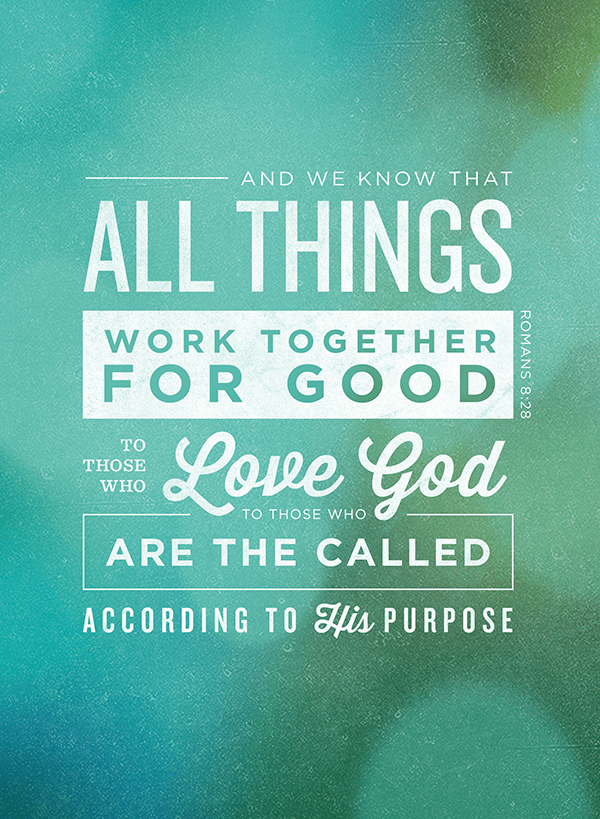
Do All Things Really Work for Good?


All Things

And we know that for those who love God all things work together for good…

Romans 8:28

This verse is often used to encourage those who are going through a tough time – reminding them that it will eventually work out for something good in their life. For example – don’t worry about getting fired – God has something better in store for you. All things work out for good, remember?

While it is a very comforting and hopeful verse, particularly while navigating though the tough circumstances of life, there are two cautions to deal with to keep this passage in its proper context:

  1. The passage deals with those who love Christ.

It may appear to be semantics. Who doesn’t love Christ, right? But it’s a very important distinction. The verse is specifically for believers – those who believe Jesus Christ is who He says He is.

  1. The “good” that is described is our ultimate conformity to Christ not our comfort.

The “good” that is referred to here doesn’t necessarily mean our circumstances will go from bad to good. Things might get better after the loss of our job, they might not. Rather the “good” is that which leads to our sanctification – growing us closer to Christ. The word literally means “useful.” It’s all about the ultimate good, that which is best for us, not necessarily that which makes us feel better.

There are times it is really difficult to see the good in life’s challenges. But remember, for those who love Christ, He is always working good in our lives. We may not see it. We may wonder. But we can be assured that all things really do work for good!


Do We Really Want to Know Why?

Suffering

Continuing in our series, Asking for a Friend, it’s the universal question: Why do bad things happen to good people? You can check out my message here https://youtu.be/Mg_Vo2JCeXA. But do we really want to know why?

Every baby’s arrival on planet earth is a memorable occasion. The birth of our second was nothing less. It was a scheduled induction a week after his due date. We arrived at the hospital and went through the customary routine. Amy was hooked up to the fetal monitor that registered her contractions and the baby’s vitals. The medication drip was started. The doctor had the rousing pre-game talk with us. And we waited. As the drip kicked in, the contractions commenced. With each passing contraction, the grimace on Amy’s face amplified. It appeared her pain was intensifying, but the monitor was only showing measly escalations. I was getting concerned because she was obviously in pain but there didn’t appear to be a reason for it. I’m smarter than I look (and I enjoy life), so I restrained from sweetly saying, “Suck it up, buttercup!” About that time, the nurse came in the room to do a regular check and noticed the monitor was not placed in the correct position. She adjusted a few things just as another contraction began and the display soared off the screen! Uh, where’s the epidural?

Imagine you are walking down a hallway in a hospital. You hear a woman crying out in pain. Standing outside her room are her family and friends who are chatting it up and even laughing seemingly unaware of the howling coming from the room. You stop and say to them, “What is wrong with you? Can’t you hear how much pain she is in?” They look at you like you are crazy and reply, “She’s having a baby! We are so happy!”

In some cases, when we know why, the pain doesn’t seem so bad anymore. We can tolerate suffering when we know why it is happening. I was bothered by Amy’s pain when the monitor wasn’t correlating with her grimaces. But once it made sense, I was better with it. And then there are other cases where even if we had the answer to why, we can’t imagine that it would possibly even come close to alleviating our pain.

Every one of us who suffers wants to know why. But what if we found the answer? What if the mystery were finally solved? If this ultimate question were answered, then would we be able to make peace with the suffering of “good” people? If we knew why we would no longer be bothered by their cry, we would no longer feel their pain, because we would understand why it is happening.

It’s the search for the why that draws us closer to God. In the middle of our suffering, we have two options. We can use our confusion, hurt and anger to draw us closer to God or we can make it an excuse to run from God. It’s also the search for why that draws us closer to others. We can enter their pain and confusion. So, let’s keep asking the question. Allow the question to draw you closer to God. In fact, allow the question to propel you into action. When you see “good” people suffering, hear their cry, feel their pain, and move into action to help them. And so, in your suffering, may you receive the same.


Is Suicide an Unpardonable Sin?

asking

We just launched a new sermon series at Aldersgate Church titled, “Asking for a Friend.” You know the questions – the ones you don’t want to ask at the risk of sounding silly or being embarrassed. Better to make your friend look ridiculous, right? We’ve learned that you have lots of friends with lots of hard questions!

One question that came up numerous times is around the matter of suicide and whether suicide can be forgiven by God. Many grapple with the question because they have a friend or loved one who has taken their own life. Some question because they have heard teaching that it is certainly an unpardonable sin. And still others are intrigued by the Netflix series “Thirteen Reasons Why” that just released its second season.

I recently sat down with a good friend of mine, Renee Ross, who is living in the wake of such tragedy. Her son, Riley, took his life at 21 years of age. Renee never asked for the platform she has but is taking full advantage of the opportunity God has given her. You can catch that interview here. It’s definitely worth your time to hear Renee’s story. Allow me to add some additional commentary here.

The Bible records six incidents where a person takes his own life: the case of Abimelech (Judges 9:50-57), Samson (Judges 16:28-30), Saul and his armor-bearer (1 Samuel 31:1-6), Ahithophel (2 Samuel 17:23), Zimri (1 Kings 16:18-19), and Judas (Matthew 7:25). In none of these is an explicit moral evaluation or judgment rendered, but it is worth noting that none of these cases were met with God’s approval.

Here is what we know:

  1. Suicide is a sin.

A traumatic event, a death in the family, a series of bad experiences, severe depression or mental illness —all of these things can lead us down into the valley of death’s shadow. But suicide is never considered to be an option for escaping a time of difficulty and despair. It is not a good conclusion and becomes a sin because it robs a person of the sanctity of life and the full time given to them by God.

  1. Suicide is not an unforgivable sin.

Nowhere does the Bible say that suicide is unforgivable or unpardonable. The Bible teaches that all sin – past, present, and future – is forgiven through the grace of God. One’s eternal destiny is sealed and set at the moment of trusting Jesus for salvation. This is the most important decision that can ever be made in life. And there is not another decision after the decision to follow Jesus (short of perhaps outright rejecting Him) that can negate that decision.

Some argue that a person who commits suicide cannot repent of the sin and therefore it is unforgivable. But who will really have the time to confess every single sin before they die? Some of us will die instantly, without warning. Others may slowly die, but even then—after we confess as many sins as we can think of—there are still sins that we have committed against God and our neighbor that we aren’t even aware of! So, the usual reason given for suicide being an unforgivable sin doesn’t seem to hold up to the Bible or experience.


There are obviously difficult and challenging questions the Bible simply does not directly address. But this one thing is certain. Suicide is always a tragedy and most assuredly a sin that violates the sanctity of life. But in itself is not the unpardonable sin. There is no evidence to conclude that it is beyond the reach of forgiveness obtained for us at the cross of Christ. The only sin God cannot pardon is the sin of rejecting him.

I’d love to hear your thoughts and struggles with this question.


Beauty and the Mess

Church

We’ve had some captivating visitors out our house this spring. A family of swallows has skillfully manufactured their home in our entryway.  It has been like binge watching episodes of “Fixer Upper” as they make trip after trip to add mud, grass and feathers to shape up their home. And then we switch to the Discovery channel as we observe the babies hatch and follow these swallows as they care for their young. It has all been quite fascinating except for one thing – they leave a big mess on our porch! But we have put up with a little mess to witness the beauty.

That’s a whole lot like the church. Beautiful but a bit messy at the same time.

I’ve been in the church for most of my life. I’ve seen the best of times and the worst of times. I’ve witnessed lives utterly transformed, marriages saved, and people healed of all kinds of physical, mental, emotional, and spiritual maladies.  And I’ve experienced the pain of getting ground up in the gears of church politics, congregational meetings that looked more like an episode of Jerry Springer, and some of the most disgraceful discrimination found anywhere on the planet. A great deal of beauty with a good bit of mess.

God’s plan to make his grace known to the world is not for a bunch of perfect people to live together in textbook harmony but rather for a gang of messed up people to cling desperately to Jesus and look to him to help in our weakness. That’s where God does his best work. We endure a little mess to behold the beauty of God.

I love the church. I love the church in all its beauty. I love the church with all its mess. I love the church because God loves the church (Ephesians 5:22-23). And that’s why I’m giving my life to it. How about you?


Laurel or Yanny?

laurel-yanny-2018-billboard-1548

A single word has divided America in two.

Are you “Team Laurel” or “Team Yanny”?

The internet has recently erupted in disagreement over an audio recording of two words that look so different on paper yet sound so alike. Some listeners hear “laurel” while others hear “yanny”.  It’s an audio equivalent of the 2015 internet controversy over whether the dress is white and gold or blue and black.

It all started when a Georgia high school student was studying the word “laurel” for her literature class and decided to look it up on vocabulary.com. She was listening to “laurel” but kept hearing “yanny”. And the rest is history. The internet worked its magic and the debate turned explosive. Those who have a propensity for higher frequencies hear “yanny” while those who prefer lower frequencies hear “laurel”.

So, is there hope for America? Can “Team Laurel” and “Team Yanny” come together? Can those who see a gold and white dress get along with those who see blue and black one? Can those who have differing interpretations on disputes such as immigration, health care, gun control, marijuana, minimum wage, and climate change sit at the same table?

God help us. Here are a few guidelines:

  1. Develop an attitude of understanding

Proverbs 18:2 states, “A fool takes no pleasure in understanding, but only in expressing his opinion.” We must learn to use empathetic listening to enter someone else’s world. While vocabulary.com is clear that it is “laurel” there is also a very clear scientific explanation for why some hear “yanny.” It is incumbent upon us to lean into understanding why someone on the other side of the table from us may see or hear things a different way.

  1. Choose to withhold judgment

“If one gives an answer before he hears, it is his folly and shame” (Proverbs 18:13). We tend to be judgmental listeners giving evaluation by our own viewpoint. May we choose to withhold judgment with our mouths and offer discernment with our ears.

  1. Give affirmation even without agreement

Ephesians 4:29 says it best. “Let no corrupting talk come out of your mouths, but only such as is good for building up, as fits the occasion, that it may give grace to those who hear.” Believe it or not, we can affirm another’s viewpoint without agreeing with it.

  1. Share your ideas only after the other person feels understood

Ephesians 4:15 urges us to “…speak the truth in love…” There is a time and place to speak our convictions. That time is only after the other person feels heard and understood.


For what it’s worth, vocabulary.com, where the debate originated, has now gotten in on the action, creating a definition for all the people on “Team Yanny”: A “yanny” is a word or phrase that is capable of distracting the entire internet for at least 24 hours. When you “drop a yanny,” you start a contentious debate on some type of public forum.

May we all be people who desire to stop dropping yannies!


What Would The World be Without You?

Light

What would sports be without the talents of Lebron James, Jordan Spieth, or the William’s sisters? What would iTunes be like without the abilities of Justin Timberlake, Selena Gomez or Carrie Underwood? Thank goodness for gifted writers like J.K. Rowling, Stephen King and Nicholas Sparks. And what would the movies be like without brilliant actors such as Chadwick Boseman, Tom Hanks and Jennifer Lawrence?

What would the world be without you?

God has gifted you! He wired you to make a contribution. God did not give you your talents and abilities for your benefit. They are for the benefit of other people, and their talents are for the benefit of you. When you use your abilities to help others, God is glorified.

“God has given each of you a gift from his great variety of spiritual

gifts. Use them well to serve one another” (1 Peter 4:10, NLT).

I am so grateful for people who are talented in areas that I’m not good at. For instance, I’m so glad there are people who have mechanical ability. I don’t know how to fix a carburetor. I don’t even know where it is!  And I’m grateful for accountants. Because I stink at accounting!

God has given me some talents. One of my gifts is taking the truths of the Bible and presenting them in a way that is conversational, applicable and challenging.  When I use that ability, you get blessed. My talent is used to help you.

But here’s the point: You’ve got talent, too. When are you going to start blessing others? When are you going to start helping others? If you don’t use your talent that God gave you, other people get cheated. The way you bring glory to God is by using your talent.

There’s no feeling in the world like doing something for God’s glory, knowing that you’re doing what He made you to do. It is the greatest thrill in the world! If you haven’t ever felt that, discover and develop the spiritual gifts that are in you so you can enjoy your life and bring glory to God.

  • What are the gifts that God has given to you?
  • How are you using them to serve others? How do you think God wants you to use them for the benefit of others?
  • How do you need to accept help from someone so that person is able to use his or her gifts to bring glory to God?